Monday, May 4, 2009

It's Just for the Birds!

My first little budgie's name was Romeo... I barely remember him because he died when I was barely 4 years old. His death was my first experience with death and I remember tucking him into a small box and, with my dad's help, having a funeral service before we buried him in a deep hole in our garden and covered the tiny grave with flowers from our garden.

My next experience with birds (outside of the usual watching the local robins and swallows outside at the birdfeeder my grandmother and mother always kept filled in our cherry tree) was watching the movie "The Birds" by Alfred Hitchcock. I was probably around 6 the first time it was shown on TV, and since my mother was (and still is) an avid Hitchcock fan, of course we watched it. Being the precocious child that I was, instead of being horrified, I was curious about why the birds had behaved the way they did. Needless to say, I was already well on my way to becoming an ecologically aware, tree hugger/animal lover.

Every chance I got, I would beg my parents to go out driving in the country and I would look for birds. When we went to the zoo, I would spend a good deal of time in the aviary, amazed by the variety of sizes and colors of the lovely winged creatures. Summer vacations at the lake in the UP of Michigan were spent with my older sister and her family and the one thing I looked forward to the most was hearing the loons' early morning calls and watching them rise gracefully out of the water, skimming the lake and just creating an incredible sight. I marvelled at the formations of the geese as they migrated south each fall, only to return each spring. Growing up in the Midwest, we had some incredibly beautiful birds that inhabited our prairies and woodland areas - the common robin, harbinger of spring, with it's beautiful red breast, or the regal blue jays and bright red cardinal males with their familiar crests, the tanagers with their sleek black bodies and bright orange-red markings on their wings, and of course the wrens and swallows and mourning doves, not quite as colorful, but still a welcome sight at any time of the year.
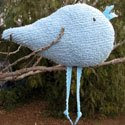
When I moved to Arizona in my early 20's, I fell in love with the new varieties of birds that inhabit the desert and mountains of my home state. I had never seen a falcon soar with its incredible 5 foot wingspan, or a hawk swoop gracefully across the desert (although if I could, I would love to be able to fly like a bird for just one day). I was amazed the first time I saw a cactus wren suddenly appear from that small hole in a saguaro. I giggled as I watched little families of Gambel's quail toddling their way across the road, almost oblivious to traffic... and of course, the roadrunner - absolutely nothing like the one that caused Wyle E Coyote so much grief. Just as fast, but strange looking in a way that reminds me that birds are one of the closest things we have to dinosaurs, that still exist.

Birds calm me... when I was going thru difficult times in my life, I would often grab a head of lettuce and a loaf of bread and head off to one of the nearby ponds to feed the ducks and swans and other water fowl that would stay here year round. I would look forward to springtime with the ducklings following their mothers to the waters edge, effortlessly following along behind her while the drake would watch protectively from the shore. Summer saw them turning into full grown playful ducks, squawking and bantering and fighting to be the first one to get to the piece of bread or leaf of lettuce I had flung out in an open area of the water.

I haven't had the need to visit "my ducks" for awhile now, but I do have an owl that visits in the winter and somehow the sight of him sitting quietly, silently on the neighboring rooftop is reassuring to me. I love watching him when he does move to his next post... his wide and powerful wings flapping, breaking the silence of the dawn. In contrast, our patio is surrounded by flowering desert bushes, and in the warmth of the summer mornings, I can look out my window pretty much any day and be greeted by the iridescence of hummingbirds as they hover near the flowers, drawing away the sweet nectar.

Yes, I think the world would be a much less interesting place without our feathered friends. Unfortunately, it is becoming apparent that the bird population worldwide is dwindling. According to the Audobon Society , since 1967 the average population of the common birds in steepest decline has fallen by 68 percent; some individual species nose-dived as much as 80 percent. All 20 birds on the national Common Birds in Decline list lost at least half their populations in just four decades. A natural progression? Survival of the fittest? Losing their habitats to urban sprawl? No matter what the cause, I for one, would definitely miss these wonders of nature. If you are interested, the Audobon link has some great information on what you can do to help...think about it the next time you see your favorite little bird singing happily from its perch.

Thank you to these shops for the bird-related items which grace this article!

Large Primitive Birdhouse Surf Shop Vintage Barn Wood Metal Roof - RachaelsGarden
Vintage German Dictionary BOOKMARK with Bird - katieblue
Peacock 5x7 inch Photograph Double Matted - JSELEP
Bell the blue bird -leahkl
Cute Original Collage - singing red bird - Cabin
EMPTY NEST - MysticWynd
Blueberry Bird Necklace - VeraLuna
EMERALD DREAMS Charm Necklace - MysticWynd
NECTAR -hand-pierced sterling silver necklace- erinbowe
The Songbird Altered Picture Frame - ThriftyTrendsetter
THE MESSENGER Great Horned Screech owl - original fine art beaded painting -thelonebeader
Chickadee on bittersweet wall Decal - MonkeyThreads

Sunday, May 3, 2009

Define "Normal" or "Natural"

Paranormal...supernatural... the mere mention of the words brings to mind thoughts and imaginings of ghosts, haunted houses, demons, psychics, exorcisms and other eerie foreboding ideas. I find it odd tho, that most people don't really attach the same feelings to other "paranormal/supernatural" things such as angels, or miracles, or even Jesus' rising from the dead (although I'm sure it gave Mary Magdelene a start). Aren't these all things that exist (or are believed and accepted by millions) outside the realm of the everyday? It's amazing to me how much the human mind fears that which it simply does not understand yet when taken out of a safe "context."

Lets look at those two words. We all know what "normal" and "natural" mean - things that we have decided are commonplace and occur regularly enough that we no longer attach anything but a sense that they are "okay." Add the prefixes "para" (which, by the way, means "beyond, past, surrounding, etc.) or "super" (exceeding, above, beyond) and these words take on a completely different and for some people, frightening connotation. In reality tho, the words simply refer to something that is outside the realm of what we have decided is "normal."

Since this is a subject which both fascinates me and makes me feel just a little uneasy, I've spent a lot of time reading about paranormal activity and the supernatural. Am I a believer in the paranormal? Yes, for the most part - for the simple fact that I know that there is still so much out there for us to learn about our existences and the world and universe that we inhabit. And more so, because I'm one of those logical people who can step back and say "just because we can't see or touch something doesn't mean it doesn't exist" - and if we define "normal" as commonplace or naturally occurring with regularity, then perhaps all of these things will someday be deemed "normal."

Remember your history lessons about man's first voyages across the seas and the frightening and supernatural monsters he encountered? The monsters that are today known as giant squid and octopi, and other "normal" forms of marine life. There was a time when epileptics were believed to be possessed by demons - now, medicine has proved that seizure disorder, while not common nor normal, is certainly not supernatural. Even illnesses were once believed to be caused by demons or other-worldly creatures torturing the human body. Today, we know those demons and creatures as tiny microscopic bacteria and viruses - things that existed then as well, but because they could not be seen or understood, were immediately relegated to the realm of supernatural cause. Psycho- or tele-kinesis (the ability to move objects with the power of the mind) was once thought to be a form of witchcraft. Today it has gained a place among the rare, but not exactly abnormal, gifts that certain people are born with.

Ghosts - one of my favorite topics, by the way, since I've had a couple personal encounters. There is just an incredible amount of conjecture and theory about what happens to the human "soul" when one dies (leaves this plane of existence). Scientific studies (which I realize many are trying to debunk) show that at the time of death, the average human body experiences a weight loss of approximately 21 grams - weight that cannot be explained away through sweating or any other "normal" phenomenon. Is this the soul leaving the body? We haven't found a way to tell for sure, but since matter cannot be destroyed, at the very least, the electrical energy that drives our heart and feeds neurons in our brain, must go somewhere at the time of our death. Does it simply drift out into space? Does it have to? So many of us believe in an afterlife (approximately 70% of people polled worldwide), but yet, the idea of ghosts still carries with it an aura of fear to those who do not truly want to accept it. Again, simply because science has not yet proven it, does not mean it does not exist.

Science is working very hard to broaden the scope of what is normal. There is talk within the scientific community of parallel universes, multiverses, multiple dimensions beyond the four currently accepted (time is the fourth dimension for those of you who are scratching your head and only remembering 3!) As physicists explore quantum theory, it may become the "norm" to accept that there are truly 10 or 11 dimensions. So, who's to say that ghosts are not simply our life energy within another dimension? And as with all matter, there are inconsistencies in the bonds between the molecules (the veil of the structure, if you will) which I believe might allow that "ghostly" energy to find its way into our dimension.

Psychic ability is another paranormal concept that is being studied scientifically with amazing results. For whatever reason (and until the actual physiology of the psychic event is dissected and normalized), some peoples' brain activity is consistent with the existence of things such as precognition (have you ever experienced deja vu in a situation you knew you had never been in before and remembered that you had dreamt of this same thing a long time ago?) trance state (it is, after all, just a learned ability to change the electrical impulses in the brain), and psychokinesis. Does this surprise me? No, not when you factor in the knowledge that we, as humans, use 10% or less of our brain's ability on the average...or that medicine and science are making great strides in figuring out what part of the brain is responsible for such things as linear reasoning, spatial ability, even artistic ability. There is 90% left to tap into - who's to say that ESP or psychic ability doesn't reside in that neighborhood? And that the people who are gifted with these abilities aren't simply using a "natural" abililty that we just haven't discovered how to tap into yet? Perhaps we will find that it can be taught, just like babies are now taught to learn colors and sounds and can recognize their own mothers by their scent.

If you are one of the 60% of people polled who say their lives have been touched by an angel - you probably consider it a supernatural event (with a positive connotation, luckily). But 60% is a majority, so perhaps because it is a positive event, it is closer to becoming considered natural and normal.

UFO's, the Bermuda Triangle, Cryptids (creatures like Bigfoot or the mothman) may seem a bit "hokey" to many of you, but to those people who have encountered or had experience with them, they are very real. And again, I think that we need to be open-minded and realize that simply because we cannot recreate something at will, or find a creature or spaceship just because we want to, does not mean they do not exist. Will we know the answers in our lifetimes? Your guess is as good as mine. When it comes to UFO's, my personal belief is that they do exist (and I'll do an article on my expanded thoughts on that in the not-too-distant future), for the simple fact that the odds of us being the only sentient and curious beings in the universe are slim to none. We're exploring space, why would we expect anything less of any other species "out there"? The Bermuda Triangle - well, there are areas of the earth where the laws of time and space and physics seem to not apply, but I would not be surprised that quantum physics will someday give us an answer to these anomalies. As for cryptids, scientists discover an average of 10,000 new plants, animals, and insects every year...perhaps their time for discovery has just not arrived, or perhaps they are more advanced than the average creature and just don't want to be discovered yet...or perhaps people have too much time on their hands. I, for one, try to keep an open mind - after all, 52 years ago, I didn't exist either!

There are many arguments, scientific and philosophical, for both sides. The proof for anything, unfortunately, is subject to our acceptance of it as true based on our limited range of experiences. Someday, perhaps in a future existence, we may find that the things that we accept as normal are really paranormal or supernatural in the grand scheme of things.

Thank you to the following shops for the use of their items to illustrate this hopefully thought provoking article!

Behind the School - Shane Gorski
sunburst, 2009 - TyeJ
Ghost - EweniqueCreations
Astrological Zodiac Portable Tarot Card DivinationTable - DragonOakDesigns at Etsy (or DragonOak.com )
CRYSTAL BALL Rainbow Clear Quartz Sphere on Stand - AlliPacha
Angel - dkjart
End of Man - EweniqueCreations

Saturday, May 2, 2009

Twinkle, Twinkle, Little Star...

Twinkle, twinkle, little star,
How I wonder what you are!
Up above the world so high,
Like a diamond in the sky!

It's probably one of the first nursery rhymes we learned and that we teach to our children and grandchildren...and it's a question that the scientific community still seeks the answers to - what are those wonderful twinkling masses that we can see every time we look to the night sky?

Astronomy, a branch of science that deals with the study of celestial objects like stars and planets and comets and nebulas and black holes, dates back to the earliest civilizations - making it one of mankind's oldest sciences. 20,000 years ago, Neolithic cave dwellers adorned the walls of their caves with paintings of the phases of the moon, shooting stars, and even supernovas. These early observations of movements in the heavens lead to the development of calendars, formed the basis for many early religions, and were critical to the planting of crops and preparation for the changing seasons.

While there is proof that virtually every early civilization from the Mayans to the Egyptions to Aboriginal tribes in Australia had studied the movement of objects in the sky, Greek and Roman cultures, as well as Chinese and Indian cultures are among the many early peoples who developed names for the shapes they saw in the heavens. These constellations, while perhaps a bit difficult to conceive perceptually in comparison to what they were named for, are still used to identify star clusters. Some of the more well known ones are the Big and Little Dippers, Orion, and of course, the constellations which lent their names to the signs of the Zodiac - Aquarius, Pisces, Aries, Taurus, Gemini, Cancer, Leo, Virgo, Libra, Scorpio, Sagittarius, and Capricorn.

In these early times, knowledge was limited to what could be seen with the naked eye, but the refinement of optical lenses and the first use of a telescope to observe the heavens by Galileo Galilei in the early 1600's led to a new age of scientific exploration and discovery that continues today.

As technology has developed exponentially, so has man's desire to understand the universe. Space exploration is no longer limited to what we can see through our telescopes from here on earth. Programs such as Voyager and the Hubble Space Telescope are providing an incredible wealth of information about our universe. We are learning about its creation, expansion and probable demise. We have the ability to study not only the planets in our solar system, but we can ascertain with some probability that there are other planets similar to ours in other solar systems revolving around other stars like our sun. We have discovered galaxies being born, supernovas dying, black holes where gravity is so strong that even light cannot escape it, and a multitude of other astronomical wonders that we are still attempting to explain.

We have learned that we are just a tiny speck of stardust in a universe of billions of stars (one source estimates it at 10 to the 24th power -that's 10 followed by 24 zeros!). So the next time you gaze up at the night sky, allow yourself to be engulfed by its sheer immensity, let your mind consider the possibilities, and say a quiet prayer of thanks for the wonder that is our universe!

Now, a somewhat less quiet thank you to the shops who allowed me the privilege of posting some of their astronomy related items to illustrate this article.
Twilight time - TimeAndMaterials
Nightime - TimeAndMaterials
Great Orion Nebula - celestialwonders
Andromeda Galaxy - celestialwonders
Retro Scifi Tech Small Tilting Table Top Telescope - buildersstudio
Leo Constellation WOMENS EGGPLANT Tee - isotope
Pioneer Spacecraft NASA plaque for Aliens T-shirt - isotope

Friday, May 1, 2009

May Day, Beltaine, Walpurgisnacht

May 1st - the magical spring day that is celebrated in so many ways in so many cultures. Since many of my ancestors lived in the lands whose festivals, spring rites, and religious groups celebrated this day, I'm taking a day to share some of the mysteries and magic of the day.

Celebrated as Beltaine (Beltane, var.), this holiday with its roots in Celtic history is primarily a celebration of the midpoint of the period between the beginning of spring and the start of summer. It was a time when livestock was released into the fields and meadows as the seasons warmed and daylight grew longer. Bonfires were lit to mark a time of purification and transition, welcoming in the season in the hope of a good harvest later in the year.

For Neo-Pagans and Wiccans (for whom it is a Sabbat), May 1st celebrates the height of Spring and the flowering of life. The Goddess manifests as the May Queen and Flora. The God emerges as the May King and Jack in the Green. The danced Maypole represents Their unity, with the pole itself being the God and the ribbons that encompass it, the Goddess. Colors are the Rainbow spectrum. Beltane is a festival of flowers, fertility, sensuality, and delight. It is said that the veil between our world and that of the Fae is at one of its thinnest points on this magical day, and many legends speak of visits by the queen of the Faeries, Maab and her court to cause mischief in our world.


Walpurgisnacht (Walpurgis Night) is a traditionally religious holiday of pre-Christian origin, celebrated by both christians and non-christians alike throughout eastern Europe. The current festival is in most countries celebrating it named after St Walpurga. Due to her holy day falling on the same day, her name became associated with the celebrations. Walpurga was honored in the same way that Vikings had celebrated spring and as the Vikings conquered Europe, the two dates became mixed together and created the Walpurgis Night celebration. Early Christianity had a policy of 'Christianising' pagan festivals so it is perhaps no accident that St. Walpurga's day was set to May 1, much like the Christian holiday of Easter is connected historically to the pagan holiday of Oester.

Bonfires were a focal point of this celebration as well in most European countries although in some places like Sweden and Finland, the festivities include fairs and carnivals as well! In England, a special christian mass called Roodmas was also celebrated at midnight on May 1st, historically believed to draw christians away from the "pagan" celebrations.

Down thru the years, many rites and rituals and traditions have been born of the original Beltaine feasts. England still observes the day with traditional English May Day rites and celebrations which include Morris Dancing, crowning a May Queen and celebrations involving a Maypole.

Catholic traditions include May crowning of Our Lady, honoring Mary as our heavenly mother. In some areas of the US, May baskets are still prepared. These baskets are usually filled with flowers or treats and left at someone's doorstep by a secret admirer. The basket giver would ring the bell and run away. The person receiving the basket would try to catch the fleeing giver and if they caught the person, a kiss was exchanged.

However you may acknowledge the first day of May, I hope it has been/will be a wonderful day for you, filled with all the promise of spring and renewal and transformation and life and love!

A heartfelt thanks to the many magical mystical shops whose unique and whimsical wares have created a sense of nature and faerie beauty for this May Day blog.

May Queen fantasy art print - strangeling
Maypole Pucks - Littlecreatures
Flower Fairy Doll- 10 inch Waldorf Style Doll w Butterfly Garden Seeds- SweetAlyssumDolls
Forest Dryad Pendant SoN - ElysianFields
Garden Guardians - 2as1
Wild Wood Fairy House with working lights pond and fairy - Centaur1201
Tiny Grass Fairy - Pendant - jMichelleBoutique
Fairy Bower Moonlight Blue Ear Cuff Vine Wrap - Thyme2dream

Thursday, April 30, 2009

Out of the Sewing Basket and Into the Jewelry Box

Today I'm going to introduce some of you to a jewelry trend that is becoming more popular - especially in a time when there is just so much creativity and willingness to experiment with non-conventional materials.

While things such as fabric covered buttons have been around for quite awhile, there is definitely a much wider arena of fabrics, such as silks, felts, yarns, and even woven metal, that is making its way into the jewelry market. The focus is opening up to embrace texture and natural materials in a variety of designs from some of the very organic and earthy felt pieces to the futuristic and much more modern metal "cloth" pieces.

Not only have fabrics found their way into jewelry design, but so has the use of such traditional "sewing" notions like buttons, thimbles, snaps, and even zippers. In a world where repurposing and recycling has come into vogue on a much wider level, it's amazing to see what the creative mind can come up with next!


These are just some of the wonderful shops on Etsy that provide this type of jewelry. Please visit them and explore new jewelry horizons! Thank you to the shop owners for the use of their jewelry photos today!

Bob Bob Bobbin Along Earrings - myauntdebbie
Opium Dream Felted Zipper Necklace Zip It -
londicreations
neck loops in peach and snapdragon - missindie
Thimble earrings 6 - ItsNotGold
COPPER MESH STERLING SILVER PATCHWORK EARRINGS - GemDesignsbyBarbara
Textile Tender Necklace, amethyst - lasidi
Turquoise brown Camel Layered Felt Flower Pin Brooch - blackcatmima
The Art Of Flirting Felt and Zipper Necklace Zip It -
londicreations
Huge Button Earrings Turquoise - lacravatteduchien
Button Up Necklace - cutyourheartout
Sewing Room Treasure Earrings snaps snaps snaps - myauntdebbie


Wednesday, April 29, 2009

A Seed-y Subject

Seed beads... those teeny-tiny wonderful little beads that add color and texture and versatility not only to some very beautiful and unique freeform jewelry designs, but also to gaments like evening gowns and bridal gowns, and a huge assortment of accessories from bridal veils to headbands to beaded bags and beyond.

The history of this little bead is pretty amazing. While modern mass production of seed beads began in Venice in the late 1400's, the earliest mass-produced seed beads were the Indo-Pacific beads of India and related places. They dominated the bead trade for nearly 2000 years. There is also evidence of small beads in King Tut's tomb - placing them back 4000 years. In more modern history, these beads were used as "currency" by English traders when trading with natives from the Americas, African and other colonies around the world.
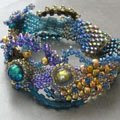
Seed beads come in a wide variety of shapes and sizes, although the common use of the term refers to tiny rounded or tube shaped beads. Sizing is done in "aughts" altho, surprisingly I wasn't able to find a standard definition of exactly how the measurement "aught" was actually derived. While the notation still is used in seed bead descriptions (ie 15/0, 6/0) beads sizes are considered in how many beads are in a linear inch. The largest of the standard seed beads is 6/0 with approximately 10 to an inch. The most common seed bead size in use is an 11/0. The tiniest seed beads ever manufactured, a 24/0, measures approximately 50+ to an inch. Seed beads measuring smaller than 15/0 had stopped being produced in the early 1900's although there are many still in existence as vintage beads. Recently, however, there has been development of micro-seed beads which measure at 18/0.

On a broader level, seed beads come in a variety of shapes. The following terms are used to describe these different types of beads:

Seed - Broad term for any small glass beads
Rocaille - Round seed bead made of hard (non-lead) glass
Bugle - Tubular seed bead of soft (lead) glass, usually not rounded, also comes in a twisted version
Charlotte - Rocaille with ground facet(s)
Macca, Cut Bugle - Bugle with hexagonal section, usually black
Two-cuts (hex cuts) - Short segments cut from maccas, also comes in a twisted version
Three-cuts - Two-cuts faceted by grinding
Ceylon Pearl - Made of alabaster glass, either lined or dyed, then lustered
Delica - Most uniform seed bead, short cylinders; computers used in manufacture
Square - reflect light in every direction and add interesting dimensions and texture when mixed with round beads
Triangle - catch and reflect additional light, adding extra sparkle and a more angular, modern look to your designs
Fringe/Magatama - These Glass Beads are almost drop shaped, but not quite. They are really a round bead with an off-center hole. They make great texture when used for bead embroidery and can be used in place of the traditional teardrop shape for many other uses.


Seed beads also come in a variety of finishes:

Transparent - the glass is see-through
Translucent - one can see light through the bead, although the light is diffused
Opaque - the solid color prevents light from passing through the bead
Matte - the bead is textured on a microscopic level to result in a matte finish
Silver-lined - a silvery coating which reflects light is applied to the inside of the seed bead
Copper-lined - a coppery coating which reflects a reddish light is applied to the inside of the seed bead
Bronze-lined - a bronzy coating which reflects a brown light is applied to the inside of the seed bead
Luster or lustre - a rainbow effect applied to the surface of the seed bead
AB or aurora borealis - also a rainbow effect applied to the surface of a seed bead

Seed beads are produced in many countries around the world, with Japanese Delica beads being considered the gold standard.


Jewelry designs using seed beads range from simply strung strands to extremely detailed and intricate patterns. Some of the more popular stitching patterns are the peyote stitch, herringbone, right angle weave, brick, square, ladder, chevron, and spiral stitch amongst others. The beads can also be woven into metal crochet or virtually any other type of woven or strung design.

Working with seed beads is painstaking and requires patience and skill to maintain uniform tension. It is also one of the most beautiful types of jewelry you will ever see, made even more so when you consider that the number of beads that must be individually handled to create some of the more intricate designs is in the tens of thousands!

I hope you've enjoyed my foray into the world of seed bead jewelry and will take a moment to click on some of the photos and explore the beauty of this wonderful jewelry art.

Thank you to the following stores for the use of their photos in this article!
Floral Necklace-Black Onyx - tavikon
Wired pearls - theBeadAerie
Brown Beaded Bangle Bracelet - rlscreations
neptune's treasure - theBeadAerie
Hemlock Wreath Reflecting Mountain Stream - Giftbearer
My Blueberry Spring - koalabei
Green and Black weaved Bracelet - aznbiotch
As You Wish Necklace - tethyis
Oceanic Pearls - MourningWoodDesign
Coral, Mauve and Raku Swirl Necklace and Bracelet Set - debbaworks

Related Posts with Thumbnails